T1_2x2_Teacher's_Manual - Planning 1


Learning and Development Objectives:
• Build and practise lexical content about everyday actions;
• Learn and practise the Present Continuous;
• Develop oral comprehension skills and practise the Present Continuous;
• Develop oral comprehension skills through video activities;
• Perform activities on the DigiWorld platform;
• Take part in games to practise vocabulary and structures, reacting to the teacher’s commands and interacting with classmates.

BNCC Skills:
BNCC Skills:
• (EF06LI19) Utilizar o presente do indicativo para identificar pessoas (verbo to be) e descrever rotinas diárias.
• (EF06LI20) Utilizar o presente contínuo para descrever ações em progresso.

Materials needed:
• Student's Book;
• Workbook;
• Video Session 2 (https://youtu.be/a10M0jGt-1E);
• ReDtech_ Fascicules;
• VLE Fascicules;
• Audio tracks:
- T1-P1-U1-SB-PG16_EX04 (https://youtu.be/VZUzTtILaqI);
- T1-P1-U1-WB-PG18_EX07 (https://youtu.be/AMgUunFvvZo).
CLASS 6
• Refer to the Introduction section of this manual for instructions on how to conduct this moment.
• Refer to the Introduction section of this manual for instructions on how to conduct this moment.

Workbook, pages 13 and 14, exercises 4 and 5
Exercise 4
Students’ own answers.
Exercise 5
a colder than
b slower than
c easier than/more difficult than
d more expensive than
e smaller than
-
1. T1-P1-U1-SB-PG16_EX04
Click to Play
• Starting up: Tell students what you usually do on a regular day. Make sure you use the everyday actions from the vocabulary section, but don’t refer students to it just yet. Then ask them what they usually do on a regular day.
• Exercise 4: Tell students to look at the pictures on page 17 and explain that they need to match them to the sentences on page 16. Play the audio once for students to complete the exercise. Ask them to correct the sentences while they listen to the recording again. Check their answers as a whole group and do some language practise with the vocabulary.
LISTENING ACTIVITY SCRIPT
Exercise 4
a (5) make the bed
b (8) read a magazine
c (1) do homework
d (6) go to school
e (7) have lunch
f (3) listen to music
g (2) take a shower
h (4) watch Netflix ™
• Exercise 5: Write on the board the following verbs: do, go, have, take, listen to and read. Elicit from students some uses for the verbs, asking them to create some sentences orally. After that, ask them to write on the board the sentences from
exercise 4 next to each verb you’ve just written.
• As soon as they finish doing it, correct the sentences on the board and call students’ attention to the boxes on page 17. They can find more uses for the same verbs. Do the activity as a whole group and remind students to complete the boxes in their books. After doing so, do some language practise using the new vocabulary.
• Exercise 6: To wrap up the vocabulary session, play a guessing game, as suggested in exercise 6, using the expressions from exercises 4 and 5. You can divide students into groups or pairs and ask them to take turns trying to guess what activity the other student is miming.
• In order to lead students into the Present Continuous, choose some of the actions from exercises 4 and 5 and mime them to students. Elicit the guesses from them and write the sentences on the board.
• Draw students’ attention to the fact that you’re doing the action right now and that’s why you’re writing sentences using the -ing form of the verbs.
• Refer them to the Student’s Book. Go over the grammar box and read each item.
• Exercise 7: Divide students into pairs and explain that they’re going to use the pictures from exercise 4 as well as the structure they’ve just learnt. Set a time limit for students to do the exercise. Walk around the classroom and monitor their work. In the end, ask one pair of volunteers to perform their dialogue to the classmates.
• Exercise 8: After practising the structure orally, it’s time to practise it in written form. Ask students to look at the table on page 19, exercise 8, and explain that
they’re going to write affirmative and negative sentences using the Present Continuous. Remind them that they can refer to the box on page 18 if they have any questions. Set a time limit for students to do the exercise. Walk around the classroom and monitor their work. Correct the exercises as a whole group.
• Exercise 9: Use the example on page 20 and explain the activity. Students must write interrogative sentences using the cue words and answer the questions according to their reality. Remind them that they can refer to the box on page 18 if they have any questions. Set a time limit for students to do the exercise. Walk around the classroom and monitor their work. Correct the exercises as a whole group.

Exercise 4
a (5) make the bed
b (8) read a magazine
c (1) do homework
d (6) go to school
e (7) have lunch
f (3) listen to music
g (2) take a shower
h (4) watch Netflix ™
Exercise 8
a John isn’t taking a selfie. He’s taking a photo of his dog.
b Mary isn’t having some ice cream. She’s eating a salad.
c Joseph and Phillip aren’t going to school. They’re going to the mall.
d Leonard isn’t swimming. He’s playing volleyball.
e Samantha and I aren’t listening to Spotify ™. We’re watching Netflix ™.
f Susie isn’t doing the dishes. She’s making the bed.
Exercise 9
a A: Is your teacher talking on the phone?
B: Yes, she is./No, she isn’t.
b A: Are your classmates doing the same exercise?
B: Yes, they are./No, they aren’t.
c. A: Is your mother sleeping?
B: Yes, she is./No, she isn’t.
d A: Is the person behind you looking at his/her mobile phone?
B: Yes, he/she is./No, he/she isn’t.
-
1. T1-P1-U1-WB-PG18_EX07
Click to Play
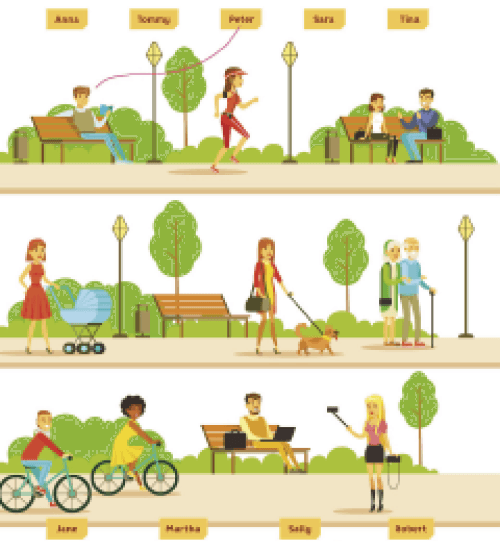
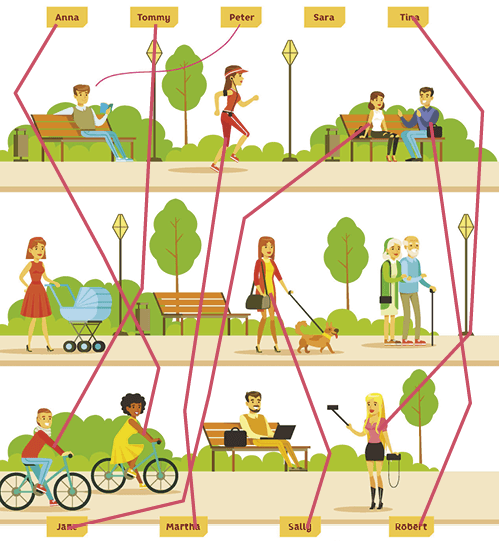
• Starting up: Call students’ attention to the pictures on page 18, which show people doing different things. Above and below the picture there are some names. Students must listen carefully to a conversation and draw a line connecting each name to the correct person in the picture.
• Exercise 7: Play the audio once for students to do the exercise. Ask them to check their answers while they listen to the recording again. Check their answers as a whole group.
LISTENING ACTIVITY SCRIPT
Exercise 7
Woman: Look, Toby. There are many people in the park today.
Man: Who’s he? I mean, the man on the bench.
Woman: Oh, I know him. He’s Peter.
Man: Is he reading a book?
Woman: That’s right. It’s the new Harry Potter book.
PAUSE 00’03”
R Can you see the line? This is an example. Now you listen and draw lines.
PAUSE 00’03”
R One
Man: That woman is walking her dog. It’s very little.
Woman: That’s Sally.
Man: Her dog loves walking in the park.
Woman: I can see. He looks happy.
PAUSE 00’05”
R Two
Man: Is that girl your friend’s sister?
Woman: Which girl?
Man: She’s taking a selfie.
Woman: Oh, yes. And she’s wearing a pink blouse and black skirt.
Man: That’s right.
Woman: That girl’s name’s Tina. She’s Sara’s cousin.
PAUSE 00’05”
R Three
Man: I know that couple. Look at them.
Woman: You mean the couple riding bikes?
Man: Yes. She’s Anna and he’s Tommy.
Woman: Are they your neighbours?
Man: Yes. We live in the same building.
PAUSE 00’05”
R Four
Man: And is that your friend’s mum?
Woman: The woman who’s jogging?
Man: Yes.
Woman: That’s right. Her name’s Martha.
Man: She loves exercising.
Woman: Yes. She always wears sports clothes.
PAUSE 00’05”
R Five
Man: Look at that couple!
Woman: Where?
Man: There. They’re on the bench. They’re chatting.
Woman: Oh, that’s Robert and Jane. They’re my sister’s friends.
Man: Oh, I see.
• Exercise 8: After finishing the listening activity, it’s time to practise some reading. Explain to students that exercise 8 is a conversation between two people. They must decide what the second speaker says each time (A, B, or C). Set a time limit for students to do the exercise. Walk around the classroom and monitor their work. Correct the exercise as a whole group. In the end, ask a pair of volunteers to perform their dialogue to their classmates.
Exercise 7
Exercise 8
1 C
2 C
3 B
4 C
5 A
6 B
Click to Play Video
 FRIENDLY REMINDERS
Not only is this the first video session of the year, but it’s also the first time students will be exposed to the characters of the videos. Tell students that they’re going to watch a fantastic series of videos during the year.
Pre-viewing procedures:
• In a fun and interactive way, ask them what the important ingredients for happiness are. Next, tell them they’re going to meet Thea and Kyle – two teenagers from the future, and they’ll have to find the seven secrets of life.
• Exercise 1: Ask students to write their guesses in their books, in the spaces for exercise 1.
While-viewing procedures:
• Play the video. Students must guess the seven secrets of life and check their answers to exercise 1.
• Exercise 2: Students must identify the relationship between the characters. Check their answers and correct any misunderstandings.
Post-viewing procedures:
• Exercise 3: After watching the extract, students must answer the questions with ‘yes’ or ‘no’. Check their answers and correct any misunderstandings.
VIDEO ACTIVITY SCRIPT
Theodora: (She’s on the floor of a white maze and slowly opens her eyes.) What is this? Where am I? Hello, is there anyone here? (She looks scared, lost, and puzzled.) (She looks around but is afraid to move forward.) What is going on? Is it a game? (She shouts.) Can someone hear me?
Kyle: There is nobody here. Nobody can hear you!
Theodora: Who are you?
Kyle: My name is Kyle. I am here to help you. I am your friend.
Theodora: Help me? Do you know who I am?
Kyle: Of course, I know. You’re Theodora Pullman. You’re 16 years old. You are from the United States. Your parents are French, but you are American. You like French fries with chocolate sundae. Oh... You don’t like strawberry sundae. Your favourite colour is green...
Theodora: OK... you know me… so where am I?
Kyle: You are in the secret maze. I am here to help you. This is my job.
Theodora: So get me out of here.
Kyle: I can’t. You are the only one who can get us out of here.
Theodora: This is crazy!
Kyle: Look! This maze has got seven doors and you have to open them.
Theodora: Okay... good. Hey, where are the keys? Are they in your pocket? Or behind these walls? Huh?
Kyle: No, they’re not. This tablet will answer all your questions. Go on! Touch it! (She touches the tablet and it is written YOUR NAME.)
Theodora: What is this?
Kyle: Go on, Theodora. It’s your destiny.
Theodora: T-H-E-O-D-O-R-A. (While he’s typing the letters, the tablet spells them out.) (She sees a picture of a man.) Dad! Is that you?
Doctor Ewan: Hello, Theodora. If you are listening to me, it means Kyle has found you. Kyle is your friend. You are in the secret maze. The secret maze has got seven doors with the seven secrets of life. You need to open all the doors before time is up to save humanity from the Magisterium. Mrs Zeelot – the Magisterium master – keeps the whole population of the world on the sleep mode and only you can wake them up. How? You need to open the seven doors and solve seven riddles to uncover the seven secrets of life. You are the chosen one. The only one whose brain is not affected by the Magisterium. Kyle is your helper. We need you, Theodora. The world needs you. I love you!
Theodora: Why me?
Kyle: Why not you? You are the chosen one!
Theodora: What time is it?
Kyle: It’s five o’clock. We have 48 hours to open the doors and come back.
(Mrs Zeelot is in a room surrounded by screens. The screens broadcast live images from around the world as well as images of the maze.)
Mrs Zeelot: So, she is in the secret Maze.
Servant: Yes, she is there, Mrs Zeelot.
Mrs Zeelot: Oh, Theodora… you are such a smart girl… You’ve always been my best student… Well, but we need to stop you. You cannot find the seven secrets of life.
Exercise 1
Students’ own answers.
Exercise 2
a friends
b student and teacher
c daughter and father
Exercise 3
a No
b Yes
c No
d Yes
• Refer to the VLE Fascicules for instructions on how to conduct this moment.
• Open the Workbook to pages 15 and 16 and explain the exercises to students. Tell them that they’re going to do some exercises to practise the content learnt in class. They should refer to the Student’s Book if they have any questions. Clarify any questions they might have about the exercises.
• Explain to students that, in the following class, they’re going to have a reading session and, this time, they’re going to read the chapter by themselves as homework. Remind them about the importance of reading the book at home; otherwise they’re not going to be able to participate in the class activity.
• Choose a game from the T1 Game Bank to be played according to your students’needs.